AI for personalised recommendations

Why it mattered

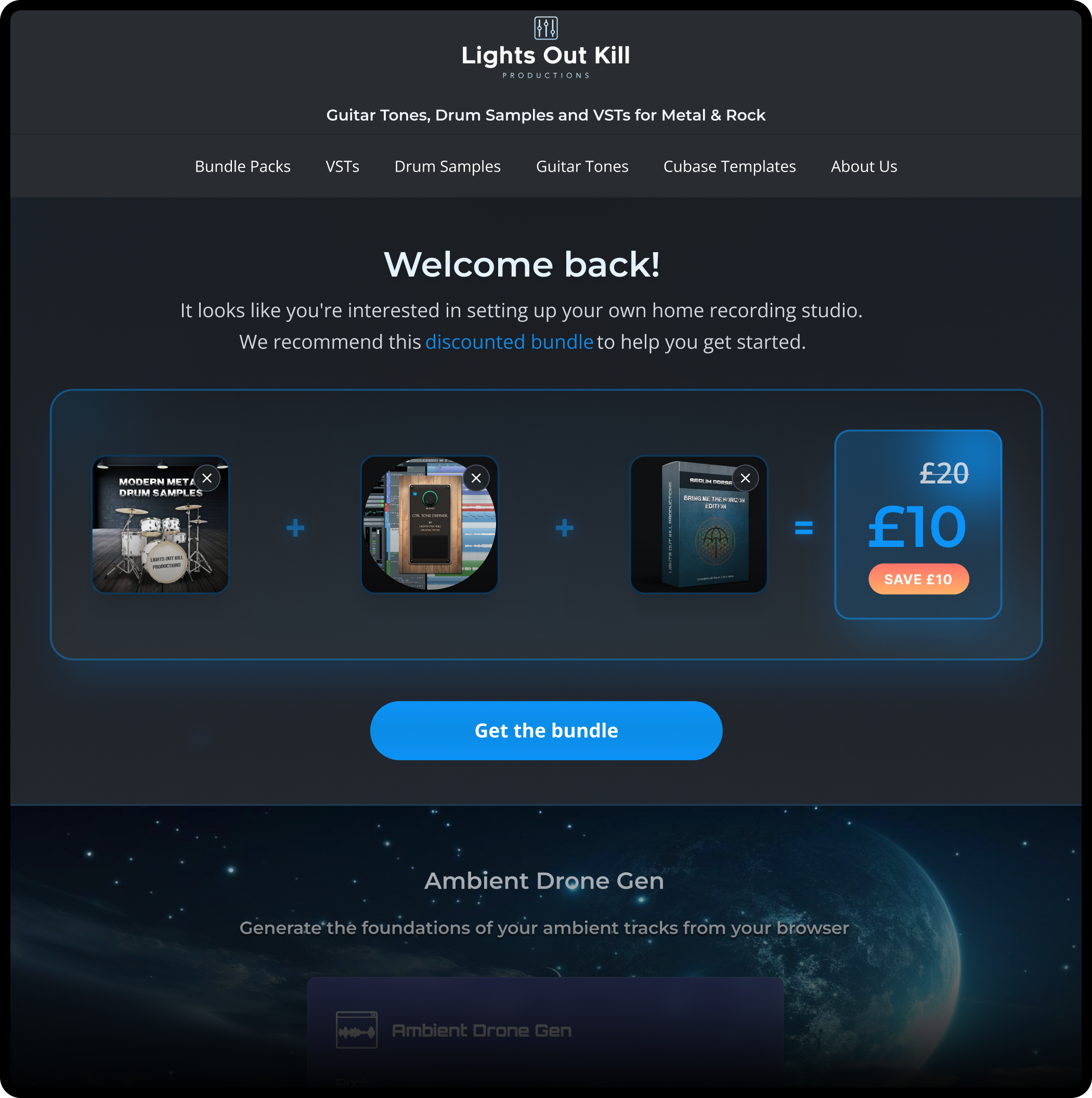
Returning users often land on generic pages that do not reflect what they are actually trying to do. I wanted to explore how AI could help create a more tailored experience.

Key decisions

  • Predicted intent based on previous user activity
  • Identified user profiles (guitarists, drummers, producers etc.)
  • Used an LLM to generate a tailored welcome message
  • Used AI APIs like “Google’s Recommendation” to build product bundles

Outcome

As an exploratory concept, success was assessed through user testing, where 70% of participants agreed that the recommendations matched their interests. The other 30% felt indifferent or did not find it useful.

Personal reflections

This exploration helped me understand how different AI services can work together to create personalised experiences, while also supporting the goal of increasing revenue per visitor.
AI for personalised recommendations visual

A kids' learning app for bilingual sound recognition

Why it mattered

My son Liam (8 months old at the time of writing) is growing up in a bilingual English–Italian family. I wanted to support early language development by helping him associate objects, people and sounds with pronunciation during the critical 6–18 months.

Key decisions

  • Focused primarily on visual and audio association
  • Used big tappable areas to maximise usability
  • Used native pronunciation in both English and Italian
  • Included real-world sounds for animals and music instruments

Outcome

Although it is still too early for Liam to pronounce words, after a week of use he consistently reacted more to certain musical instruments and animal sounds, suggesting early recognition and preference.

Personal reflections

Designing for children requires extreme simplicity. This is a parent supervised learning tool rather than a passive entertainment app, reinforcing how clarity and focus can create calm, effective educational experiences.

Your browser does not support the video tag.

Agenda generator for stakeholder presentations

Why it mattered

Every week we present our design ideas to stakeholders using a very loose process. No clear agenda, no time ownership, and discussions often ran over, leaving little or no time for questions or decisions.

I wanted to introduce just enough structure to improve focus without adding overhead to the team’s workflow.

Key decisions

  • A quick form to fill, so agenda items could be created automatically
  • Integrate Supabase with Figma Make to store the agenda items
  • A logic that warns when time limits are exceeded
  • The possibility to re-arrange the order of the agenda items
  • A utilitarian look and feel, but not 'boring'

Outcome

During the first two months of use, around 80% of sessions ended on time or slightly earlier, which had never happened before. This ensured all presenters were able to share their work while still leaving time for questions.

Personal reflections

Rather than solving the entire presentation process, focusing on time visibility and shared structure helped align multiple contributors without reducing flexibility.

Agenda generator for stakeholder presentations